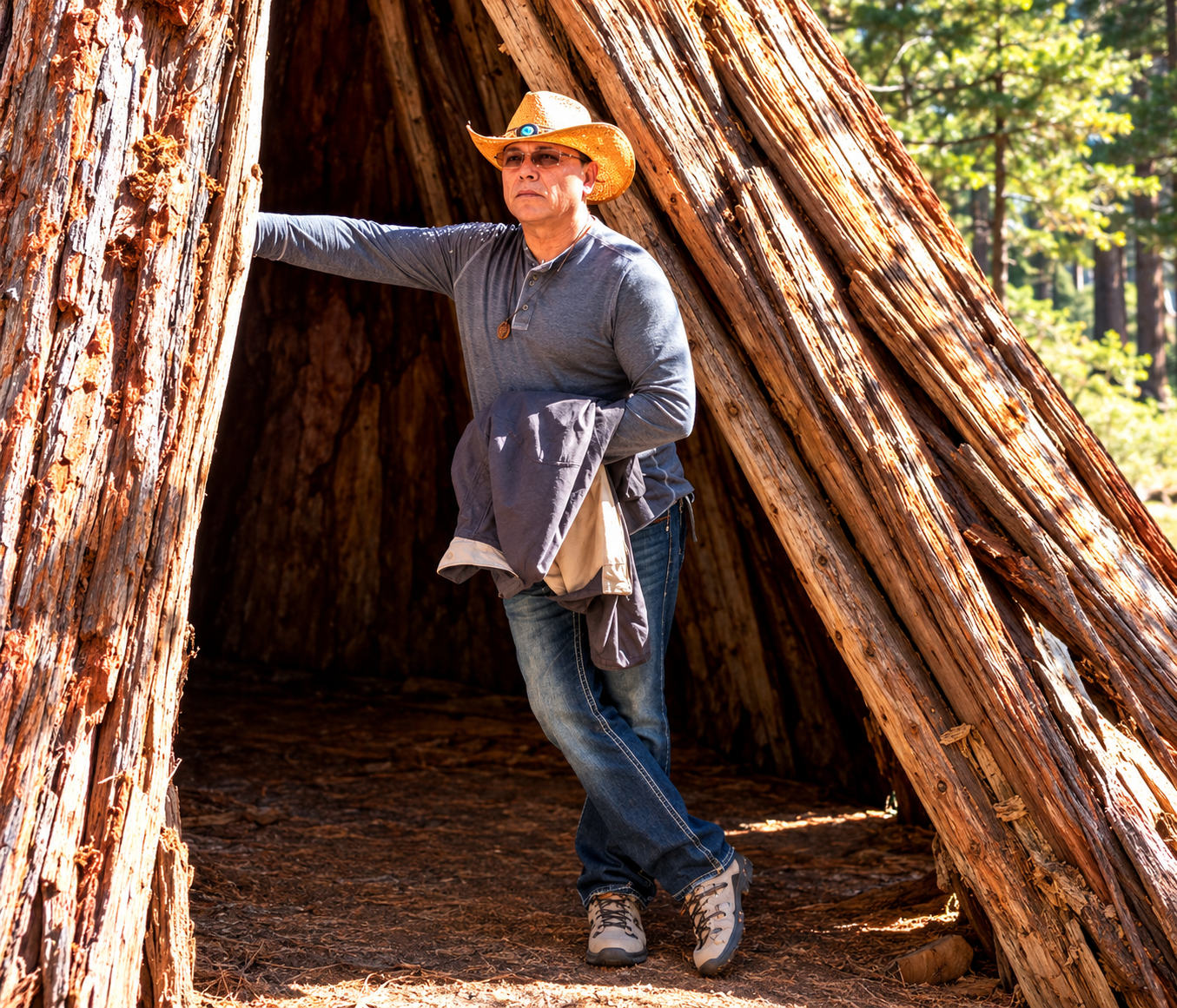
Before a story is written down, it is lived. Before a teaching reaches the next generation, someone must care enough to remember it. And long after those who carried the teachings have gone, their voices can remain—in a song, in the marks upon stone, in the words of a grandmother, or in the quiet conviction of someone who refuses to let them fade.
For Gillie Bear Heart, preserving the past has never meant living in it. It means knowing that the lives of those who came before him are still part of the life he chooses to lead.
Southern California is where his spiritual journey took root. But the questions stirring within him carried him farther—across the broad landscapes of the Southwest and into the Pacific Northwest, drawn to ancient cave art, petroglyphs, and pictographs. To some, these may be weathered markings on rock. To Bear Heart, they are traces of human lives: evidence that people stood there, saw the world through their own eyes, and left something behind. He has devoted years to researching, documenting, and helping protect those images, not to possess the past, but to keep its presence from being forgotten.
Yet the deepest teachings did not come from a distant canyon or a painted stone. They came from home. His maternal grandmother, Lilly Paris (Chihene), spoke to him of his Chiricahua roots, of their ancestors, and of the Creator. Through her, heritage was no longer an abstract idea or a name in a history book. It had a voice. It belonged to his family. What she passed down did not end with childhood; it followed him into adulthood, shaping how he listens, how he carries himself, and how he understands his place in a story far older than his own.
The drum and the song became another part of that story. At powwows throughout California, he found connection through rhythm and community, drumming and singing northern songs with Dancing Cloud, based in San Diego County. Voices rising together, the heartbeat of a drum, families gathered in one place—these were never simply moments on a calendar. They showed him that tradition remains alive when people come together to practice it.
Over the years, his pursuit of spiritual renewal has taken him into sweat lodges, where he sought cleansing of mind, body, and spirit. He has also walked in sacred circles with elders, uncles, and aunties from many peoples and communities, including Yaqui, Apache, Chumash, Mission Indian, Lakota, Navajo, Osage, Cherokee, Zuni, Aztec, and Lenape. Those experiences are not trophies to display. They are relationships to honor, reminders that wisdom is received through listening, respect, and the willingness to keep learning.
But some of the most enduring lessons of his life were learned without ceremony. They lived around the family kitchen table, where stories passed from one person to another as naturally as food was shared. They lived in long conversations, community barbecues, family outings, and moments spent with people of different generations. In those ordinary gatherings, he came to understand something extraordinary: history is not always delivered in grand speeches. Sometimes it is spoken quietly across a table, and the one who listens becomes its next keeper.
That same spirit runs through his creative life. A visual artist, conceptual designer, inventor, and craftsman, Bear Heart has always valued the power of an idea made visible. Art can awaken memory. A handmade object can begin a conversation. A story, told with care, can give someone a sense of belonging. To him, creativity and cultural preservation are not separate pursuits. Both begin with paying attention to what matters, and both ask that something meaningful be carried forward.
As the founder of Apache Bronco, he brings that conviction into community work: gathering Apache families and descendants, honoring their histories, and working so the next generation will inherit more than scattered pieces of a past. Names matter. Family memories matter. The knowledge carried by those who came before matters. When people are overlooked in the written record, the obligation to remember them does not disappear. It becomes more urgent.
He understands that the twenty-first century demands change. He does not believe the answer is to fear every new idea or turn away from the world ahead. His belief is more demanding: we must learn to walk into the future without abandoning the wisdom that gave us our footing. Tools will change. Times will change. But respect for ancestors, devotion to community, and the duty to pass knowledge forward must remain living commitments.
For Bear Heart, the meaning of his journey is not found in titles—traditionalist, ceremonialist, elder, artist. It is found in what those words require of him: to listen when it would be easier to speak, to protect what others might overlook, and to honor the people whose names may never appear in a history book but whose lives continue through the families who remember them.
Gillie Bear Heart moves forward carrying the voices of those who came before him—not as fading echoes, but as a living presence in the choices he makes and the work he leaves for those yet to come.